
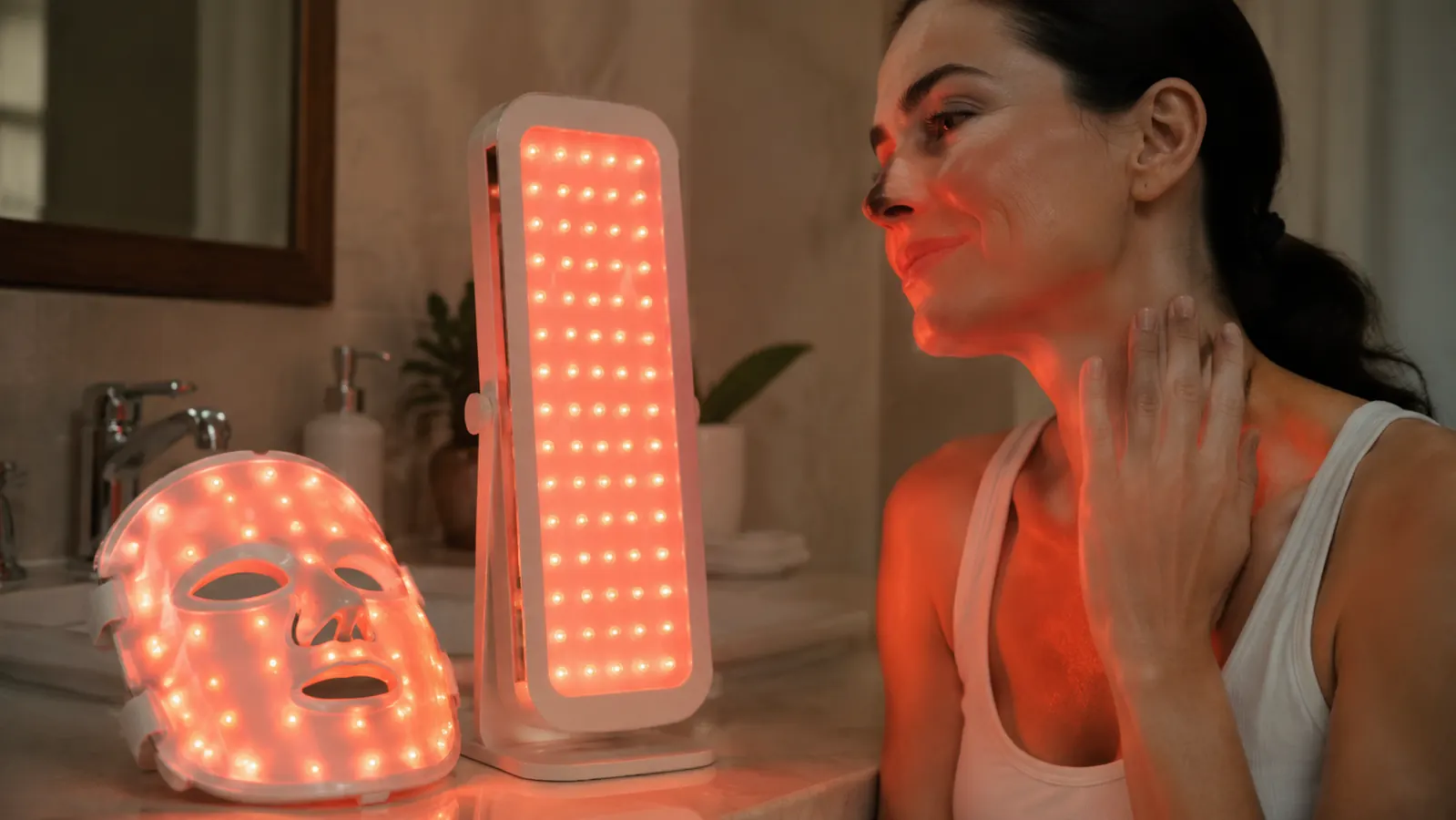
Short answer: if you want a red light routine that survives past the first two weeks, the NVBOTY mask wins. I ran it against a standalone LED panel for six weeks each, same time of night, same skincare underneath, same skin. The light itself wasn't the deciding factor. Both devices put out red and near-infrared wavelengths in a similar range, and on paper their spec sheets read almost identically. What actually decided the winner was something a lot simpler and a lot less exciting: whether I did the session at all on a given night.
I drive long hours for work, and by the time I get home my face has usually spent all day getting hit with dry cab air and sun bouncing off the windshield. My skin feels tight and a little dull by evening, and the last thing I want after a long shift is a routine that demands I stand still in front of a mirror. That single detail turned out to matter more than any spec sheet. The panel sat on a shelf in my bathroom collecting dust after nine days. The NVBOTY mask is still in my nightstand drawer, and I've used it four to five nights a week since March. That's the whole story in two sentences, but the details are worth walking through if you're about to spend real money on either setup.
Neither device is a bad piece of hardware. That's actually what made this comparison interesting to run instead of obvious from the start. If you read the specs side by side before buying either one, you'd assume they'd perform about the same, and in terms of raw light output, they basically do. The gap only shows up once you live with them for weeks instead of days, which is exactly the part most listing pages and quick unboxing reviews never get around to testing.
| NVBOTY Mask | Standalone LED Panel | |
|---|---|---|
| Price Point | Mid-range, one-time cost | Similar or higher depending on panel size |
| Hands-Free Use | Yes, straps on and worn while doing other things | No, must stand or sit still facing it |
| Session Length Needed | 10-15 minutes, timer built in | 15-20 minutes, no built-in timer on most models |
| Face Coverage | Full face including under-eye and jaw contours | Flat coverage, misses curves and profile angles |
| Wavelengths | Red 630nm, near-infrared 850nm, plus blue and orange modes | Usually red and near-infrared only, varies by brand |
| Portability | Rechargeable, 2000mAh battery, fits in a bag or a truck cab console | Bulky, stays on a shelf or counter, not built for travel |
| Eye Comfort | Padded eye area, can close eyes and relax during use | Bright direct light, most people need separate goggles |
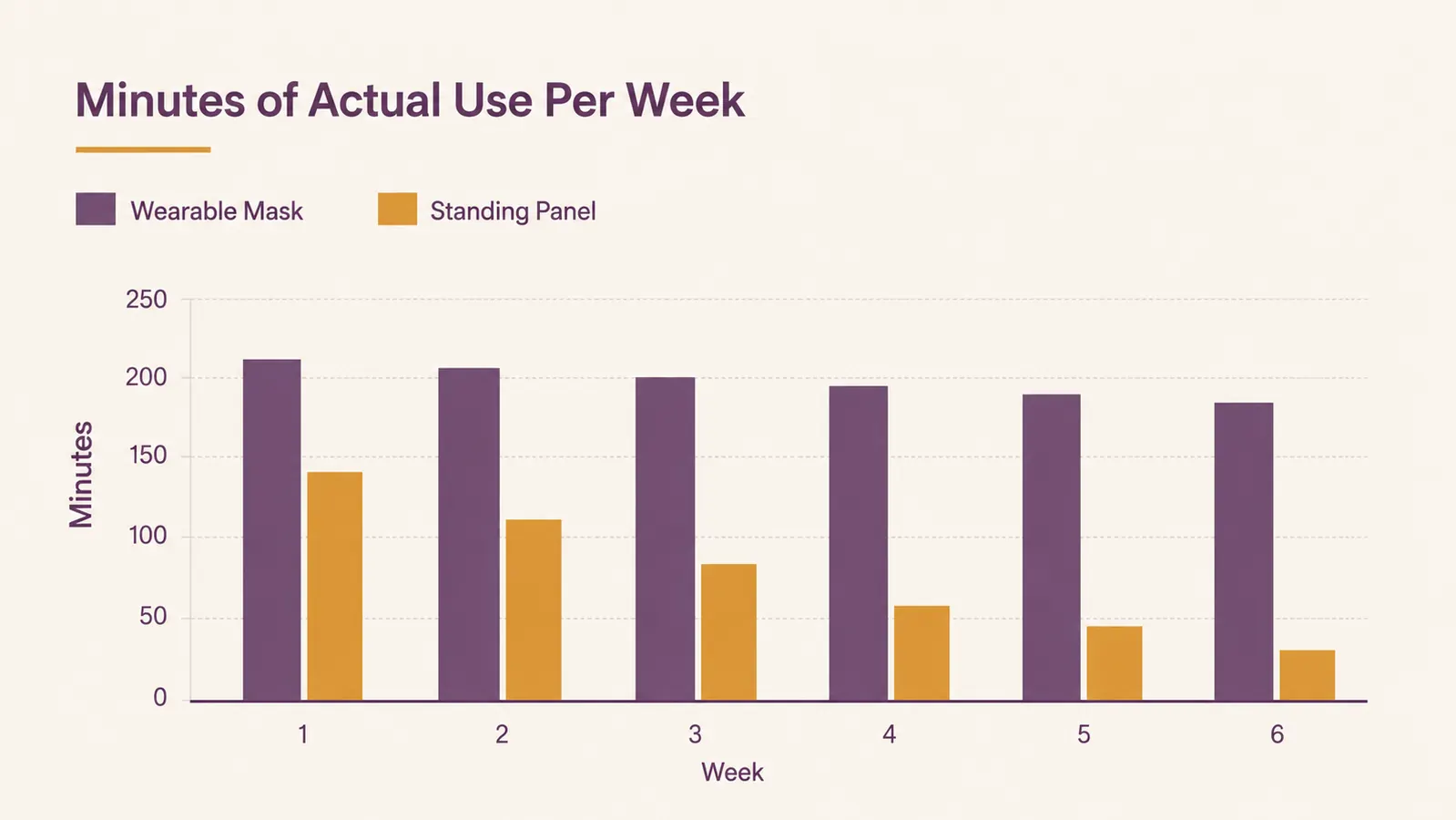
| Realistic Weekly Use | 4-5 sessions once it's part of a routine | 1-2 sessions before it gets skipped |
How I Actually Tested Both
I didn't want to just glance at spec sheets and call it a comparison, so I gave each device its own six-week block, back to back, with the same nightly skincare underneath both (a gentle cleanser, then whichever red light device was up that week, then a plain moisturizer). I logged every session in my phone's notes app the same night it happened, no relying on memory later. I also kept the room, the time of night, and the length of session as close to identical as I could manage, aiming for 12 to 15 minutes each time.
What I was tracking wasn't just skin texture, though I did watch for that. I was mostly tracking adherence, meaning how many nights out of seven I actually followed through. That's the number most reviews skip, and it's the number that actually determines whether either device does anything for your skin six months from now. A device that works perfectly in a lab means nothing if it's sitting in a drawer by week three.
I also weighed in the small stuff, the kind of detail that never makes it onto a spec sheet but shapes whether a routine survives a real week. Things like how long it took to set up each session, whether I needed both hands free to get it positioned right, and whether I could still hear the TV or a podcast clearly with the device on. Small friction adds up fast on a Tuesday night when you're tired and just want to lie down.
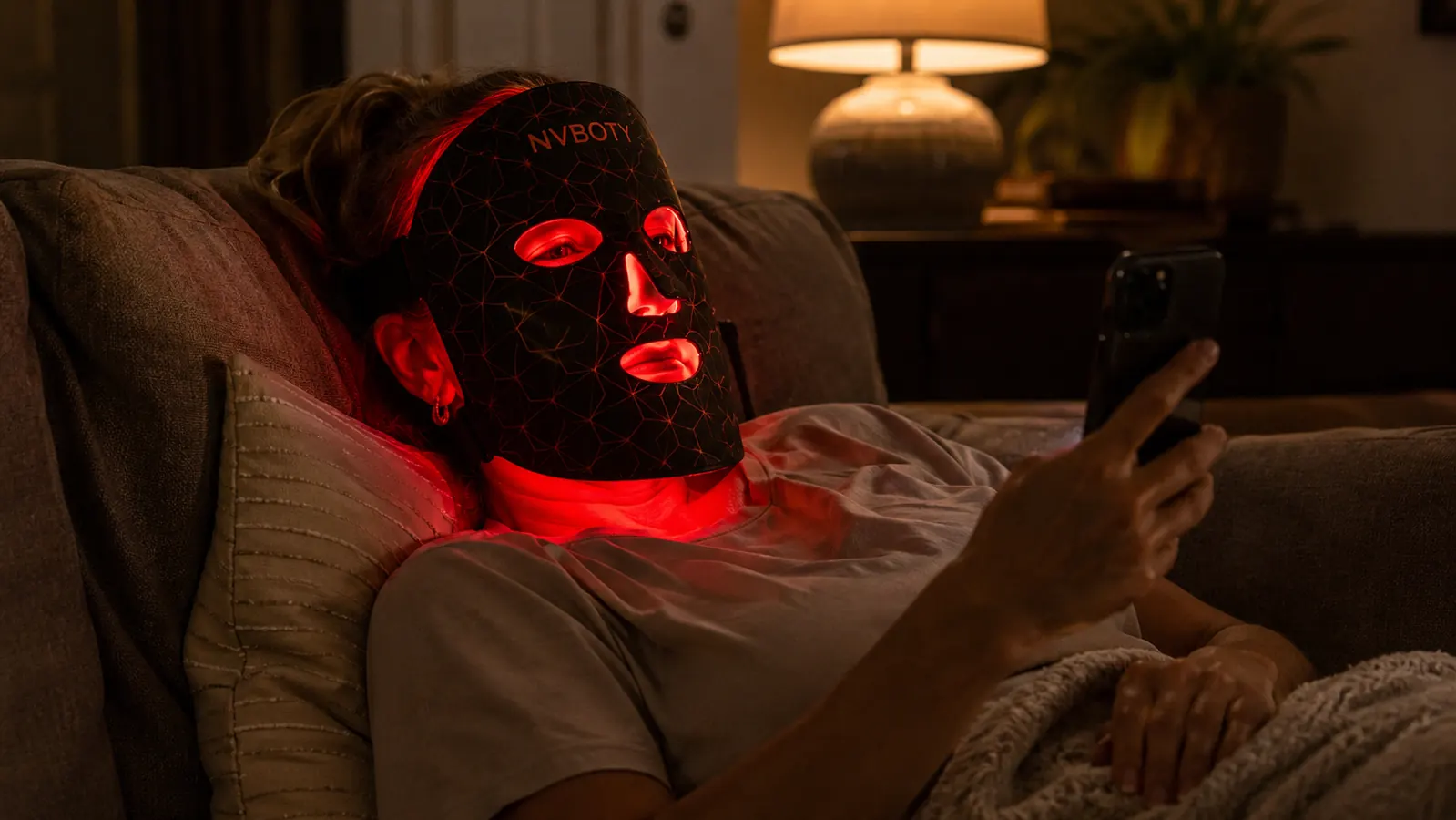
What the Skin Actually Showed
By the end of the mask's six-week block, the tightness I usually feel by evening after a long driving day had noticeably eased, and my skin looked less dull under bathroom lighting, especially across the cheeks and around the mouth where dryness tends to settle in on me first. Texture felt smoother to the touch, and a couple of fine lines near my eyes looked slightly softer, though I want to be honest that this kind of change is gradual and subtle, not a before-and-after transformation photo.
The panel's six-week block showed some of the same direction of change, just less consistently, and I think that's the honest, boring truth here. On the nights I actually used it for the full session and covered my whole face evenly, the results looked comparable to the mask. The problem is that happened less often, and the areas the panel struggled to reach evenly, my jaw and under-eye zone, showed the least improvement of anywhere on my face.
So the light itself isn't really the variable that separates these two. Consistency and coverage are. A near-identical wavelength delivered four nights a week to your whole face is going to outperform the same wavelength delivered inconsistently to only part of your face, every time.
Where the NVBOTY Mask Wins
The biggest difference is what I could do during the session. With the mask on, I could fold laundry, answer texts, or lie on the couch with my eyes shut and just let the fifteen minutes pass. With the panel, I had to stand roughly eight to ten inches from the light and hold still, angling my face toward it and then rotating every few minutes to try to catch my cheeks, jaw, and forehead evenly. Fifteen minutes of standing still in a bathroom, staring at a wall, is a much harder habit to keep than fifteen minutes of half-watching a show or scrolling through the day's messages.
The mask's curved design also means it actually follows the contour of your face instead of asking your face to line up with it. The panel is flat, so unless you're standing dead center and staying perfectly still, parts of your face end up getting less light than others. My under-eye area and the sides of my jaw barely registered any warmth from the panel most sessions. With the mask strapped on, I felt even, consistent warmth across my whole face, including the spots the panel just couldn't reach without me twisting and holding an awkward angle for a full quarter hour.
There's also the travel factor, which matters more than I expected going in. The mask runs off a rechargeable 2000mAh battery, so it comes with me. I've used it in a hotel room after a long haul, and I've used it sitting in the cab during a break when the schedule allowed. A panel isn't going anywhere. It needs a wall outlet, a flat surface, and a room where you're willing to stand still, which rules out most of the places I actually spend my evenings when I'm not home.
Skip the standing-still routine that never sticks
The NVBOTY mask straps on in seconds and lets you do literally anything else while it works. That's the difference between a habit and a device that ends up in a drawer by week three.
Amazon Check Today's Price on Amazon →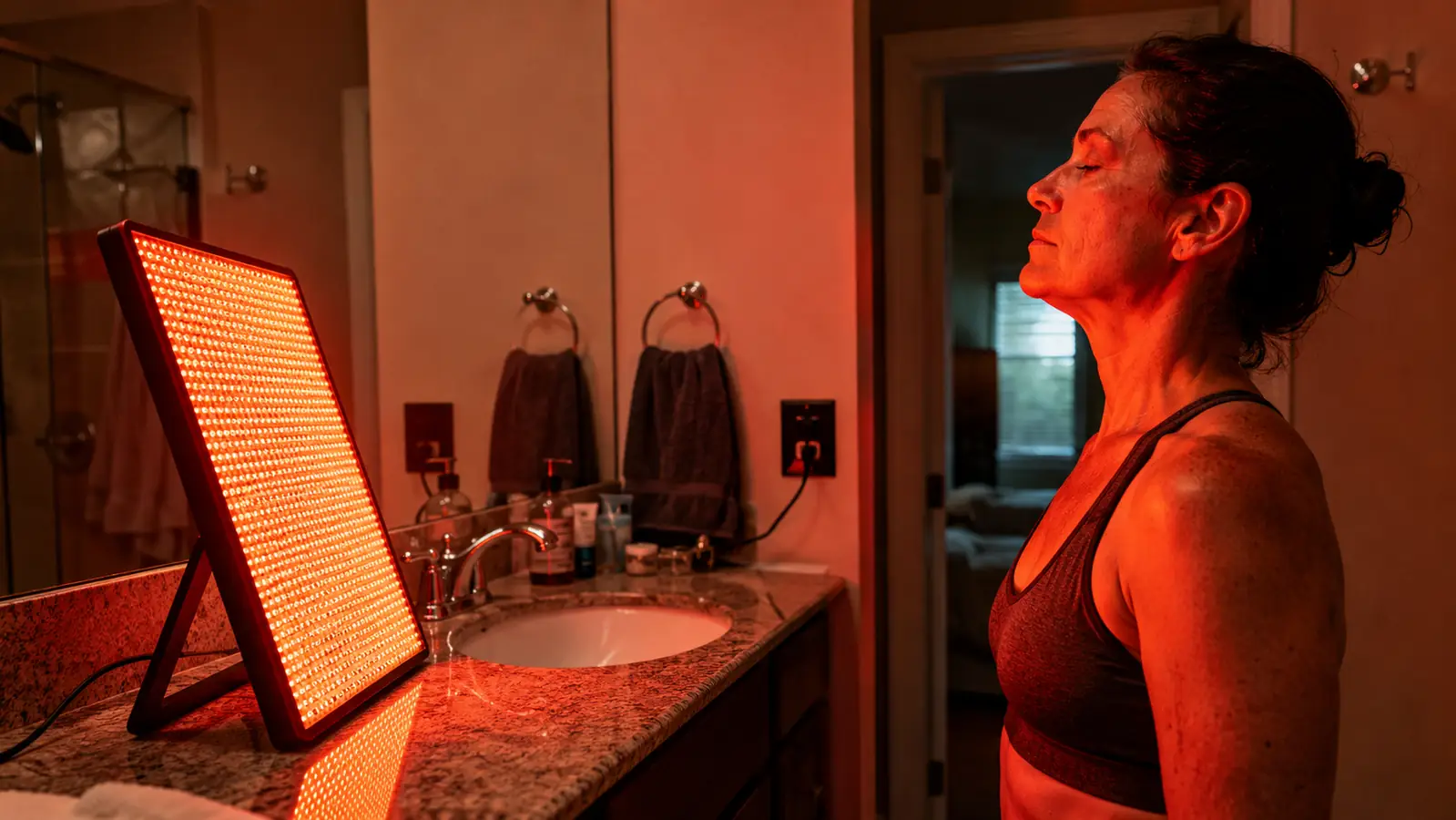
Where the LED Panel Wins
I'll give the panel this much: if you're treating a larger area than just your face, like your neck, chest, or shoulders after a physically hard day, a panel covers more surface area at once without needing multiple passes. It's also easier to share with a partner or a roommate since there's no fitting or sizing involved, you just stand in front of it and go. If you live with someone else who also wants red light sessions, a panel avoids the wait for a single mask to charge and swap hands between uses.
Panels also tend to sit further from the skin, which some people find more comfortable if they don't like anything touching their face, especially in warmer months when a worn mask can feel a little warm against the skin after ten or twelve minutes. If you already have a dedicated spot to mount or prop a panel where you'll genuinely stand in front of it every single night, that removes a lot of the friction I personally ran into during my six weeks with it.
A panel can also make sense if your bathroom mirror routine is already locked in, meaning you already stand there every night brushing your teeth or doing your skincare anyway. Bolting a red light session onto a habit that already exists is a real strategy, and if that's your setup, the extra minutes might not feel like much of an ask. I just didn't have that kind of fixed evening routine to attach it to, and I suspect most people don't either.
The panel never lost a lumen of brightness. It lost my attention, and that's the only stat that actually matters for a device you're supposed to use every day.
Who This Setup Is For
If your goal is a consistent face routine you'll actually stick with past the first month, get the mask. Hands-free isn't a gimmick line on a listing page, it's the entire reason most people finish a full six-week course of anything, whether that's red light therapy, a supplement, or a gym habit. Nobody sticks with something that requires them to stop everything else and stand still. If you drive for a living, work long shifts, or just want your evening back while the light does its job, the mask is the one that survives real life.
If you want a shared, larger-coverage setup for a whole household and you already have a dedicated spot for it, a panel can still work, but budget extra discipline into the plan. You'll need to actually stand there every night without a phone in hand, and in my experience that discipline runs out faster than people expect. For anyone treating just their face, which is most people reading this, the mask covers more of the actual target area with less effort required to get there.
If I'm being fully honest about my own six weeks with each one, the deciding factor wasn't a lab number or a feature I read about beforehand. It was simply which device I still reached for on night twenty-eight without having to talk myself into it. That's the mask, every time, and that's the whole reason it's still in my nightstand drawer instead of packed away somewhere I'd forget about it.
Get the setup built for real routines, not good intentions
The NVBOTY mask fits into the fifteen minutes you already have at the end of a long day, not fifteen minutes you have to carve out standing in front of a mirror.
Amazon Check Today's Price on Amazon →